Hydraulic Profiling Tool
Continuous relative permeability profiling, 20 readings per foot. Characterize hydrogeologic conditions, identify preferential flow paths, and design remediation injection programs with confidence.
When to use HPT
How it works
Continuous permeability + lithology profiling in one push
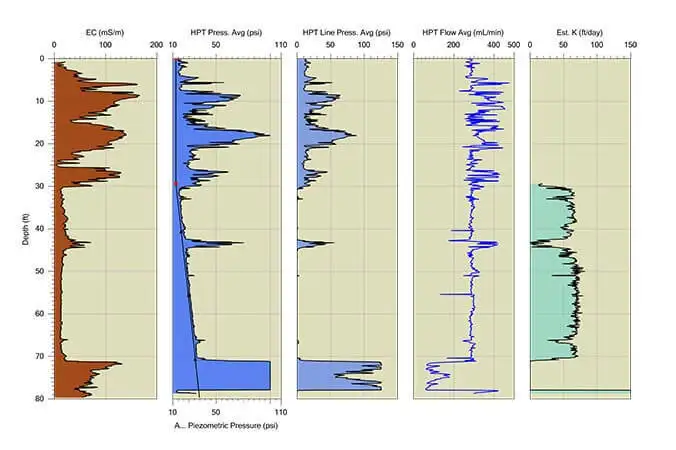
HPT measures the pressure required to inject water into the formation as the probe advances — a direct indicator of relative permeability. Combined with electrical conductivity, it produces a continuous dual-parameter profile of the subsurface that can be used to estimate hydraulic conductivity and identify transmissive zones for injection well placement and remediation design.
Formation sensors
HPT PressurePSI
Hydraulic injection pressure measured continuously with depth. Higher pressure indicates lower permeability formations (clays, silts), while lower pressure indicates higher permeability (sands, gravels). Used to identify transmissive zones and confining units.
Electrical ConductivitymS/m
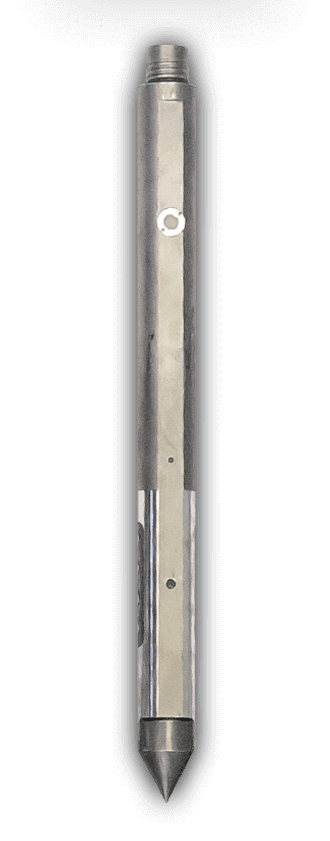
Differentiates fine-grained soils (high EC: clays, silts) from coarse-grained soils (low EC: sands, gravels). The standalone HPT uses a Wenner electrode array for finer lithologic resolution than the Dipole array on OIHPT and MIHPT probes.
Reading HPT data
Clay / Silt — Aquitard
Low permeability confining layer. Acts as a barrier to contaminant migration. Important for understanding vertical contaminant distribution.
Sand / Gravel — Aquifer
High permeability transmissive zone. Preferential pathway for contaminant migration and groundwater flow. Ideal target for injection wells.
Silty Sand / Sandy Silt
Transitional zone with intermediate permeability. May transmit contaminants but at slower rates than clean sands.
Interbedded / Heterogeneous
Rapid alternation between formation types. Common in glacial till, alluvial deposits, and fill materials. Requires careful interval-by-interval interpretation.
Need permeability profiling?
HPT provides the foundation for understanding subsurface hydraulics. Contact us to add permeability profiling to your investigation program.