Membrane Interface Hydraulic Profiling Tool
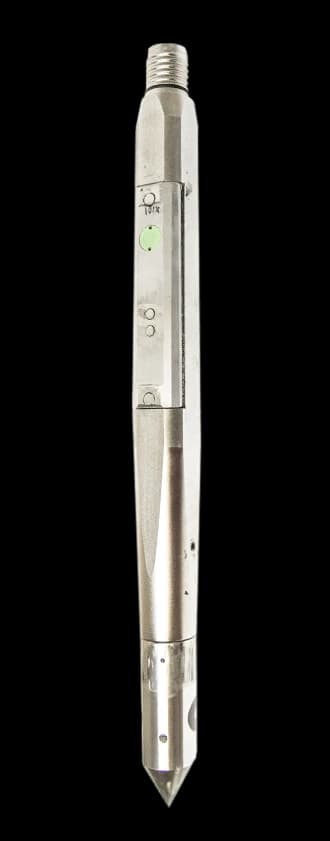
MIHPT combines three laboratory-grade VOC detectors with hydraulic and electrical conductivity sensors — detecting dissolved, sorbed, and vapor-phase contamination while profiling permeability and lithology, 20 times per foot.
When to use MIHPT
How it works
Three laboratory-grade detectors + hydraulic profiling in one push
A heated membrane on the probe tip allows VOCs to diffuse into a carrier gas stream, which transports them to three detectors at the surface. Simultaneously, HPT and EC sensors profile the formation — so every VOC observation comes with the geologic context needed to interpret it.
VOC detectors
PIDPhotoionization Detector
Broad-spectrum VOC detector. Responds strongly to aromatic hydrocarbons and some chlorinated compounds. The most general-purpose MIP detector.
FIDFlame Ionization Detector
Total hydrocarbon indicator. Responds to carbon-containing compounds including aliphatic hydrocarbons that PID does not detect.
XSDHalogen-Specific Detector
Selectively detects halogenated compounds. When XSD responds, chlorinated contamination is present. When XSD is flat, the contamination is non-chlorinated.
Formation sensors
HPTHydraulic Profiling Tool
Measures relative formation permeability. High injection pressure indicates tight formations (clays); low pressure indicates permeable zones (sands) where contaminants migrate.
ECElectrical Conductivity
Differentiates fine-grained soils (high EC: clays) from coarse-grained soils (low EC: sands). Provides continuous lithologic context alongside the VOC detectors.
How the detectors work together
PID and FID respond to a wide range of volatile organics. The XSD responds only to halogenated compounds. Comparing the three detector responses reveals what type of contamination is present.
Petroleum hydrocarbons
BTEX, gasoline, diesel
PID and FID respond strongly to aromatic and aliphatic hydrocarbons. The diagnostic indicator is a flat XSD — the absence of XSD response confirms no halogenated compounds are present.
Chlorinated solvents
TCE, PCE, DCE, vinyl chloride
All three detectors respond. PID and FID both detect many halogenated compounds — TCE and PCE have low ionization potentials and produce measurable FID response. The diagnostic indicator is an elevated XSD, which confirms halogenated compounds are present.
Mixed plumes
Co-mingled petroleum + solvents
High PID and FID driven by the petroleum component. Low to moderate XSD response indicates a co-mingled halogenated component alongside the dominant petroleum signature.
Low Level MIHPT
For trace-level VOC detection below standard MIP sensitivity thresholds. Low Level MIHPT uses a pulsed carrier gas system that sends controlled bursts across the membrane instead of continuous flow, concentrating analytes for approximately 10x greater sensitivity.
The same PID, FID, and XSD detectors are used — it is the sampling mechanism that changes. Ideal for plume boundary delineation, post-remediation verification, and sites where standard MIHPT shows minimal response but contamination is suspected.
Need multi-parameter VOC screening?
Contact us to discuss how MIHPT can support your next investigation.